In daily life, attacks target phones, laptops, and cloud accounts more than ever, so taking control of defenses matters.
Effective results come when you Protect Your Data Using Security Apps that encrypt traffic, harden logins, and watch for threats in real time.
Mobile adoption continues to climb worldwide, placing more financial, health, and personal information on pocket devices every year. GSMA estimates billions now access mobile internet services, underscoring why privacy and security tooling cannot remain optional.

What Security Apps Do
Security apps shield devices, accounts, and networks against malware, account takeovers, data leaks, and phishy prompts.
Layers typically include malicious app detection, encrypted connections, hardened authentication, and behavior monitoring that flags unusual transfers or downloads.
Strong tools also simplify safe defaults, limiting data exposure through sandboxes, secure containers, and permission controls that block unnecessary access.
Core Types of Security Apps
Practical coverage comes from a small stack that fits everyday use. Focus on categories that meaningfully lower risk without adding heavy maintenance or confusing workflows.
- Antivirus and anti-malware: Scan for malicious software and block risky behaviors across apps and files. Google Play Protect checks apps before installation and continuously scans devices, warning or removing harmful software when detected.
- VPN for public Wi-Fi: Create encrypted tunnels that prevent local eavesdroppers from reading unencrypted traffic on open networks; still confirm sites use HTTPS to keep page content private. FTC guidance explains why the lock icon and “https” matter on every visited page.
- Secure password manager: Store unique, long passwords, generate new ones, and sync safely across devices so credential reuse disappears.
- Privacy-focused browser: Reduce tracking through default protections against cross-site cookies, fingerprinting, and intrusive scripts; Brave documents layered defenses that block common tracking techniques.
- end-to-end encryption apps: Keep message contents readable only to the sender and the intended recipient, even if networks or servers are monitored.
How Security Apps Protect Data
Encryption converts readable data into ciphertext during storage and transport, making intercepted content useless without keys.
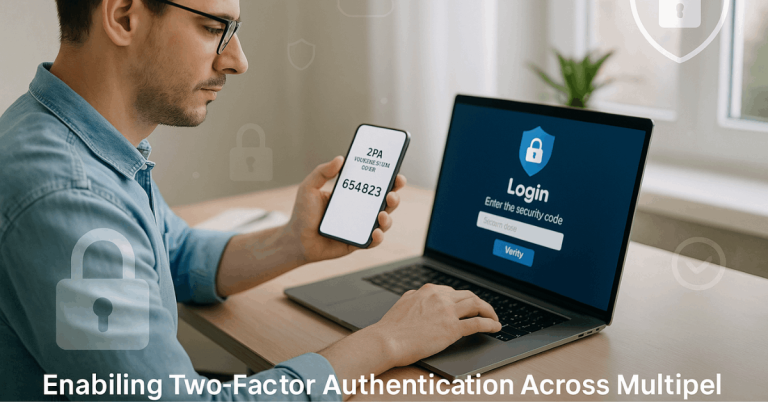
Strong authentication adds two-factor authentication or multi-factor checks and biometrics, ensuring only authorized users reach accounts or vaults. Access control restricts what each app, role, or session can read or modify, minimizing exposure when devices are shared or tokens leak.
Data loss prevention tools watch for sensitive fields or large transfers, automatically blocking risky uploads or alerting administrators. Before we proceed in diving deeper, you should at least know these key mobile security terms:
- White-box cryptography protects embedded cryptographic keys inside software, frustrating extraction during reverse engineering.
- Hashing algorithms produce fixed-length “fingerprints” for files and passwords, simplifying integrity checks and safe verification without storing raw secrets.
- Secure APIs enforce authenticated, authorized exchanges between apps, services, and third-party providers.
- Code obfuscation transforms readable logic into harder-to-analyze forms, raising the cost of cloning or tampering. Forensic watermarking marks streamed media to trace leaks. Runtime Application Self-Protection (RASP) instruments apps to observe behavior and block live attacks.
- A zero-trust security model assumes no user or device is inherently safe, requiring continuous verification and least-privilege access. NIST codifies Zero Trust principles and migration steps for real environments.
Biggest Security Risks on Mobile
Growing capability brings a wider attack surface; the following threats explain most incidents.
- Code tampering and reverse engineering: Attackers modify apps to inject malware, steal keys, or bypass license checks.
- Insecure data storage: Credentials, tokens, or sensitive records left unencrypted on the device can be extracted after theft or compromise.
- Phishing and social engineering: Fake prompts or messages trick users into surrendering OTPs, passwords, or recovery codes, thereby defeating basic protections.
- Device loss or theft: Unlocked phones with weak passcodes or no remote wipe leave email, files, and chat histories exposed.
- Malware and exploits: Malicious apps and drive-by downloads capture screens, log keystrokes, or intercept network sessions despite browser HTTPS.
Key Factors for Mobile Application Security
Authentication enforces identity through passcodes, biometrics, and second factors, while session limits, secure cookies, and device binding reduce hijacking windows.
Authorization follows role-based or attribute-based models to ensure users touch only the data required for their task.
Encryption standards plus modern TLS protect data in transit; certificate pinning helps prevent man-in-the-middle manipulation against trusted endpoints.
Code Integrity
Code integrity relies on signed releases, anti-tamper checks, and obfuscation that blocks patching and inspection.
Storage security avoids keeping sensitive records at rest; when storage is unavoidable, encrypted containers and platform keystores protect keys.
Frequent updates close vulnerabilities quickly using signed delivery channels and staged rollouts that reduce update risk.
What’s Driving Risk in 2025
Increased mobile usage places payments, health records, and workplace apps on the same handset, attracting credential-stealing malware and financial scams. Supply-chain exposure rises when apps embed multiple third-party SDKs, inheriting their vulnerabilities and data-sharing practices.
Device-level flaws occasionally bypass sandboxes, prompting urgent updates and reinforcing why signed, prompt patching deserves non-negotiable status. Even official app stores sometimes host malicious or policy-breaking apps briefly, making Play Protect and equivalent platform defenses essential safety nets.
Apple’s Secure Enclave, hardware encryption, and platform protections further reduce fallout when application processors face compromise, illustrating why modern platform features matter.

Mobile App Security Best Practices
A handful of disciplined habits cover most modern risks without slowing daily work.
- Apply strong identity controls: Turn on two-factor authentication everywhere, prefer device-bound passkeys where available, and revoke old tokens during resets. NIST’s Zero Trust model reinforces continuous verification across users and devices.
- Minimize permissions: Grant only what an app legitimately needs; audit camera, mic, location, and contacts access quarterly.
- Harden communications: Enforce HTTPS with current TLS, enable certificate pinning for high-risk flows, and avoid plaintext local logs.
- Strengthen the app itself: Use code obfuscation and RASP, monitor integrity, and remove outdated third-party libraries promptly.
- Test continuously: Schedule penetration testing and align development against mobile app security best practices such as OWASP MASVS requirements.
Quick Tool Stack for Individuals
Private browsers limit data trails and block numerous trackers that map identities across sites. Privacy email providers offer end-to-end encryption, minimal logging, and anonymous aliases that reduce inbox profiling.
Data-removal services help automate broker opt-outs, shrinking public data footprints over time. A reputable VPN for public Wi-Fi adds another layer when traveling or working in cafés; pair it with vigilant HTTPS checks to avoid fake login pages on captive portals.
Balanced suites that bundle monitoring, identity alerts, antivirus, and password management can simplify upkeep for families requiring one subscription and coherent dashboards.
Data Protection vs Data Privacy
Data privacy defines who can access personal data and under which circumstances, while data protection implements the controls that actually restrict access to that data.
Users often choose privacy settings for profiles, apps, and browsers, while companies bear responsibility for implementing encryption, access controls, secure storage, and incident response.
Effective programs treat the two as inseparable: clear privacy choices supported by verifiable technical enforcement. Platform-level capabilities, such as Apple’s hardware encryption and Android’s Play Protect scanning, add baseline protection that well-chosen apps can extend.
Conclusion
Under a small, disciplined stack, security apps harden logins, encrypt traffic, and spot threats quickly.
Pair a password manager and strong authentication with private browsing, vetted VPN use on public Wi-Fi, and timely updates. When permissions stay minimal and backups remain regular, your data stays private, resilient, and recoverable.
Start today by enabling 2FA, auditing app access, and consolidating tools that deliver measurable protection.